

September-October 2008 ESIP Journal
 |
| In order to study how contaminants may have an affect to the North Atlantic Right Whale we focus our studies on investigating if a compound causes DNA damage. Represented in the picture is North Atlantic Right Whale chromosomes in which they have 42 chromosomes; unlike us humans who have 46. In our experiments we expose the Right Whale cells to a certain chemical and analyze each chromosome for damage (breaks, gaps, centrosome spreading etc.). |
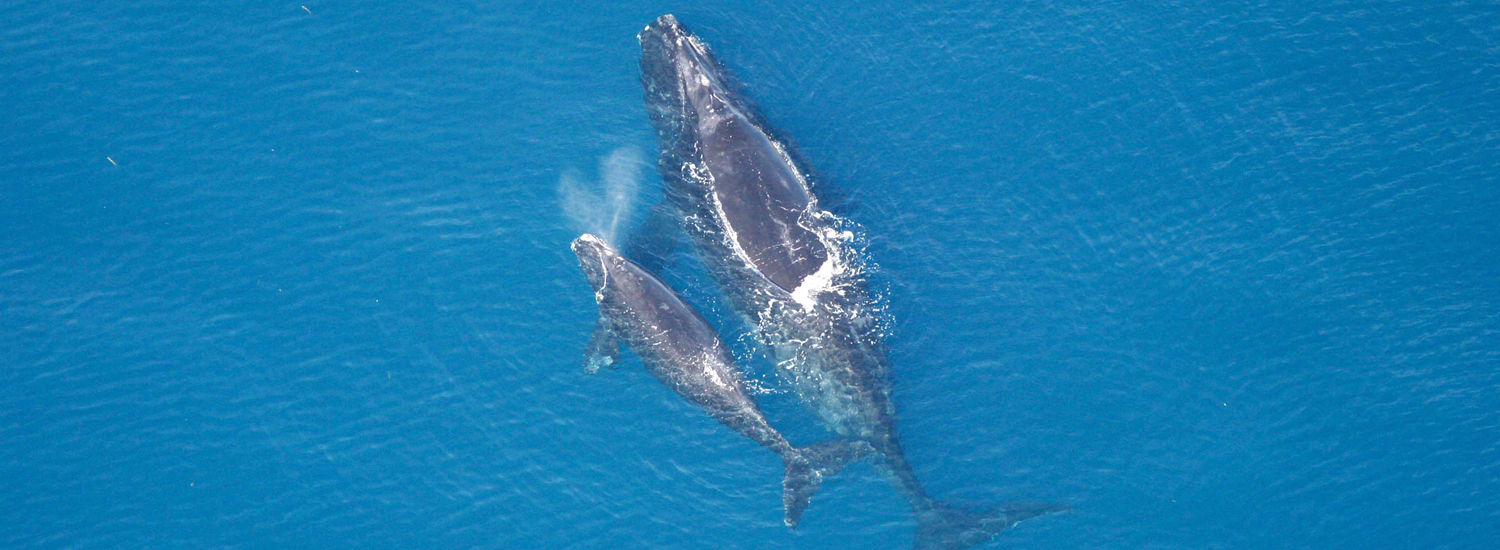
The North Atlantic Right Whale is the most severely endangered large whale, with less than 400 animals left in their population. These whales are a coastal species in which they specifically feed and reproduce off the eastern coasts of Canada and the United States. The underlying cause for the inability of these animals to recover in population size is unknown and is likely due to a combination of factors. We (the Wise Laboratory of Environmental and Genetic Toxicology) are investigating the hypothesis that environmental contaminants are playing a significant role in their
population decline. We are currently investigating the genotoxic effects of
environmental contaminants in right whales by using right whale cell lines. Cell lines are important tools for our basic understanding of many biological processes and it is one of the best methods available to study how chemicals affect right whales. In collaboration with the New England Aquarium we were successful in developing cell lines from right whale lung, skin and testis.
We have found that hexavalent chromium is genotoxic to right whale testis, lung and
skin cells. Moreover, using North Atlantic right whale skin biopsies, we have found
that the whales have very high chromium levels. These chromium levels previously
have only been reported in lung tissue occupationally exposed chromium workers.
Although it is unknown how the whales are exposed it does indicate that chromium is
a concern.
These studies will greatly enhance our knowledge of the physiology and toxicology of
the right whale. Moreover, it will create tools (cell lines) that can serve as right
whale-specific models, which can be used to better understand additional aspects of
right whale genetics, physiology, immunology and biochemistry, as well as
investigations into the effects of other contaminants and infectious agents. It will
also allow us to evaluate the levels of contaminants found in the Gulf of the Maine by
using the North Atlantic Right Whale as a sentinel species.
Our future work will be concentrated on furthering and completing our contaminant
work in the North Atlantic Right Whale. We will continue to collaborate with the New
England Aquarium on the right whales and also with Ocean Alliance, with whom we
will study free ranging sperm whales. With our future data we hope to gain more
knowledge on the toxicology of whales and what contaminants they are being
exposed to off of the coast of Maine.
Contact information:
John P. Wise
Other News in the Gulf of Maine & Bay of Fundy
Past Journals
 Febuary 2015 — ESIP releases new smartphone app connecting people in the Gulf of Maine and watershed to the science happening all around them.
November 2015 — The launch of a marine debris program in the Bay of Fundy.
September 2015 — Climate Change Products for Atlantic Canada.
July 2015 — An update from the April 2015 State of the Bays Symposium in Massachusetts.
June 2015 — Learn about NH Department of Environmental Services' work with 65 volunteers to improve beach grass coverage at Hampton Beach State Park.
May 2015 — Nova Scotia recently released risk ratings for storm serge and sea level rise for all portions of the Province - this journal summarizes the findings
April 2015 — Learn about an exciting project between ESIP and EPA that seeks to unravel upstream pressures on downstream estuaries
February 2015 — Meet the new Project Leader for the Gulf of Maine Coastal Program in Falmouth, Maine - Jed Wright.
January 2015 — New Smart Tour of Great Marsh - largest continuous stretch of salt marsh in New England, extending from Cape Ann in Massachusetts to New Hampshire
December 2014 — The American Lobster Settlement Index is an important project that assesses current lobster fishery condition in both Canada and the US. The dataset is current and available through the ESIP Indicator Reporting Tool
Click here for all past ESIP journals