

March-April 2012 ESIP Journal
U.S. Geological Survey
Woods Hole Coastal and Marine Science Center
Woods Hole, MA
Woods Hole Oceanographic Institution
Woods Hole, MA
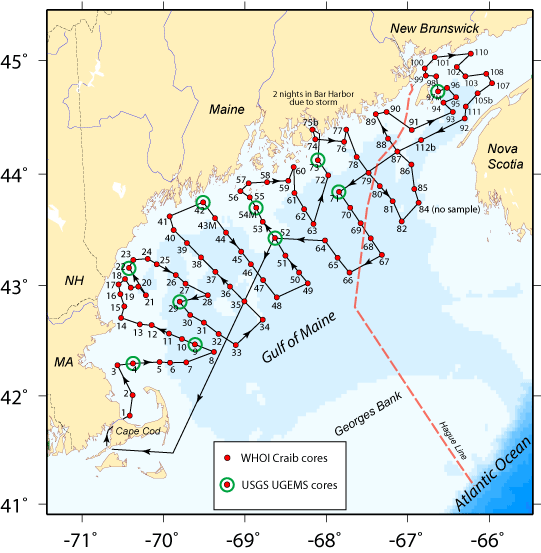
Figure 1. Cruise track for RV Oceanus Cruise 477 carried out in the Gulf of Maine from October 23 to November 4, 2011. Sediment samples for cyst and sediment texture analysis were obtained at 109 stations (red dots) using a Craib corer. Cores for erodibility measurements were obtained at 10 stations (greencircles) using the USGS hydraulically damped corer. Cores for erodibility measurements were also obtained at stations 4, 15, 42, 54, 73 and 97 in 2010 on RV Endeavor 486. |
USGS research is focused on the role of sediment resuspension and transport processes as they affect the distribution of Alexandrium cysts. Present modeling efforts carried out by investigators at North Carolina State University (NCSU) and WHOI use the concentration and distribution of cysts in the sediments as measured in a fall ‘cyst-map’ survey as input to a coupled hydrodynamic and biological model to predict the occurrence of blooms in the spring. One hypothesis is that sediments and Alexandrium cysts may be resuspended and redistributed during the winter by strong storms such as northeasters. The magnitude of bottom stress, the force on the sea floor caused by the combined action of currents and oscillatory wave-induced flow, determines sediment resuspension. A key parameter needed to predict the possibility of resuspension of sediments and associated cysts is the ‘critical stress’ required to initiate movement of sediments.
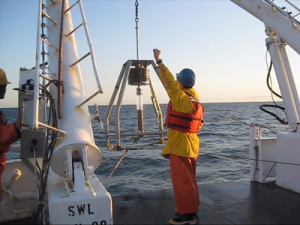 Figure 2. Recovery of USGS hydraulically damped core aboard RV Endeavor in the Gulf of Maine in October 2010. The corer is designed to obtain an undisturbed sample of the surficial sediments; the speed that the core barrel is pushed into the sediments by the weights is controlled by a hydraulic piston. The corer weighs about 1000 lbs(about 450 kg) in air. The nearly horizontal sediment-water interface and the clear water above are evidence that the surface of this core was undisturbed and is a good sample for measuring the erodibility of the surficial sediment. Figure 2. Recovery of USGS hydraulically damped core aboard RV Endeavor in the Gulf of Maine in October 2010. The corer is designed to obtain an undisturbed sample of the surficial sediments; the speed that the core barrel is pushed into the sediments by the weights is controlled by a hydraulic piston. The corer weighs about 1000 lbs(about 450 kg) in air. The nearly horizontal sediment-water interface and the clear water above are evidence that the surface of this core was undisturbed and is a good sample for measuring the erodibility of the surficial sediment. |
USGS has participated in two fall cyst surveys led by WHOI (Endeavor 486 from October 10-23, 2010 and Oceanus 477 from October 23 to November 4, 2011) to measure the erodibility of the surficial sediments. On Oceanus 477,replicate cores were obtained at 10 locations (figure 1) with a USGS hydraulically damped gravity corer designed to collect undisturbed samples of the surficial sediments (figures 2 and 3). Replicate cores were obtained at 6 locations in 2010 on Endeavor 486 (5 were resampled in 2011). Measurements to determine the critical stress and the number of cysts in the eroded sediments were carried out onboard using a University of Maryland Gust Erosion Microcosm System (UGEMS) (figure 4).
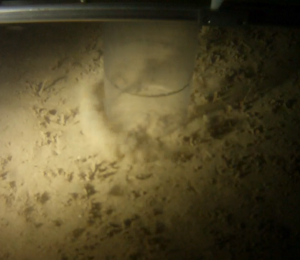 Figure 3. Screen shot from a video obtained with a camera mounted on the USGS corer showing the core tube penetrating sediments offshore of Grand Manan Island in the Bay of Fundy (station 97, figure 1). Although sediments are resuspended outside the core tube, the sediment surface on the inside of the tube is undisturbed. Success in obtaining an undisturbed core was best when seas were calm and the core could be lowered to the sea floor very slowly (speeds less than 10 m/min). The outside diameter of the core barrel is about 10 cm. Figure 3. Screen shot from a video obtained with a camera mounted on the USGS corer showing the core tube penetrating sediments offshore of Grand Manan Island in the Bay of Fundy (station 97, figure 1). Although sediments are resuspended outside the core tube, the sediment surface on the inside of the tube is undisturbed. Success in obtaining an undisturbed core was best when seas were calm and the core could be lowered to the sea floor very slowly (speeds less than 10 m/min). The outside diameter of the core barrel is about 10 cm. |
Storms affected both cyst-map cruises, reducing the number of stations that could be sampled in the allotted time and changing the planned route to minimize exposure to winds and waves. On Endeavor 486 in 2010, sampling was suspended on October 15-16 because of 15-foot waves caused by a northeaster; high seas and 20 knot winds continued to slow sampling for several days thereafter. On Oceanus 477 in 2011, Oceanus took refuge in Bar Harbor Maine on October 29-30 to avoid an intense winter storm that caused 28-footwaves in Jordan Basin. Storms such as these are nearly certain to episodically resuspend sediments in shallow water where the wave-induced currents are large. Further research is needed to determine the spatial extent, frequency, and magnitude of sediment resuspension associated with winter storms.
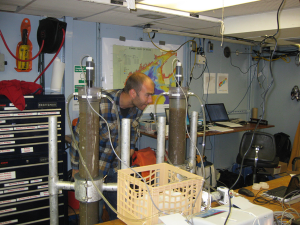 Figure 4. Pat Dickhudt measuring sediment erodibility in the laboratory of RV Endeavor using the University of Maryland Gust Erosion Microcosm System (UGEMS) in October 2010. A rotating plate is installed in the core barrel above the sediment-water interface; an increasing sequence of known stresses is applied to the surficial sediment by increasing the rotation rate of the plate.Water is withdrawn from above the sediment, filtered, and weighed to determine the amount of sediment eroded at each stress level. The concentration of cysts in the eroded sediments is also determined, providing a measure of the number of cysts in the upper few millimeters of the sediment core. Figure 4. Pat Dickhudt measuring sediment erodibility in the laboratory of RV Endeavor using the University of Maryland Gust Erosion Microcosm System (UGEMS) in October 2010. A rotating plate is installed in the core barrel above the sediment-water interface; an increasing sequence of known stresses is applied to the surficial sediment by increasing the rotation rate of the plate.Water is withdrawn from above the sediment, filtered, and weighed to determine the amount of sediment eroded at each stress level. The concentration of cysts in the eroded sediments is also determined, providing a measure of the number of cysts in the upper few millimeters of the sediment core. |
Of note: Cruise 477 was the next to last scientific voyage of RV Oceanus; she was retired from the University-National Oceanographic Laboratory System (UNOLS) fleet in November after 36 years of outstanding service to the research community.
Any use of trade, product, or firm names is for descriptive purposes only and does not imply endorsement by the U.S. Government.
Other News in the Gulf of Maine & Bay of Fundy
Past Journals
 Febuary 2015 — ESIP releases new smartphone app connecting people in the Gulf of Maine and watershed to the science happening all around them.
November 2015 — The launch of a marine debris program in the Bay of Fundy.
September 2015 — Climate Change Products for Atlantic Canada.
July 2015 — An update from the April 2015 State of the Bays Symposium in Massachusetts.
June 2015 — Learn about NH Department of Environmental Services' work with 65 volunteers to improve beach grass coverage at Hampton Beach State Park.
May 2015 — Nova Scotia recently released risk ratings for storm serge and sea level rise for all portions of the Province - this journal summarizes the findings
April 2015 — Learn about an exciting project between ESIP and EPA that seeks to unravel upstream pressures on downstream estuaries
February 2015 — Meet the new Project Leader for the Gulf of Maine Coastal Program in Falmouth, Maine - Jed Wright.
January 2015 — New Smart Tour of Great Marsh - largest continuous stretch of salt marsh in New England, extending from Cape Ann in Massachusetts to New Hampshire
December 2014 — The American Lobster Settlement Index is an important project that assesses current lobster fishery condition in both Canada and the US. The dataset is current and available through the ESIP Indicator Reporting Tool
Click here for all past ESIP journals