

September 2012 ESIP Journal
Water Canaries
Lesley Carter and Kelly Cowper, Environment Canada
Do you remember how coal miners used canaries to alert themselves of changes in the air quality when they were deep within the mines? How about using water canaries to do the same thing for our rivers?
We all know that there are no such things as water canaries, but there are organisms that live in the water that can give us important information about the quality of water flowing in our rivers. These creatures are called benthic macroinvertebrates (bugs that live on the bottom of rivers and lakes that are big enough to see with the naked eye). They live in all freshwater ecosystems and include the larval stages of many insects (ex. mayflies, dragonflies, mosquitoes) as well as other animals such as worms and mites.
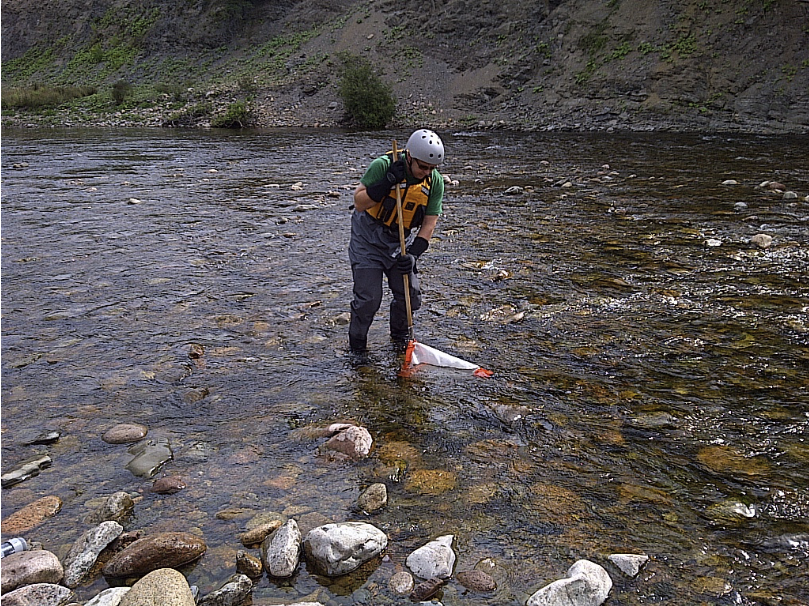 Todd Smith from Environment Canada kick net sampling for benthic macroinvertebrates in Nova Scotia. (August 2012) Todd Smith from Environment Canada kick net sampling for benthic macroinvertebrates in Nova Scotia. (August 2012) |
In 2006, Environment Canada launched the Canadian Aquatic Biomonitoring Network (CABIN). This national aquatic biomonitoring program uses these underwater bugs to assess the health of freshwater ecosystems in Canada.
Benthic macroinvertebrates provide a great deal of information about the water they are living in. They each have specific environmental conditions that they like to inhabit. By studying them, we can measure the effect, impact, and damage to the water quality.
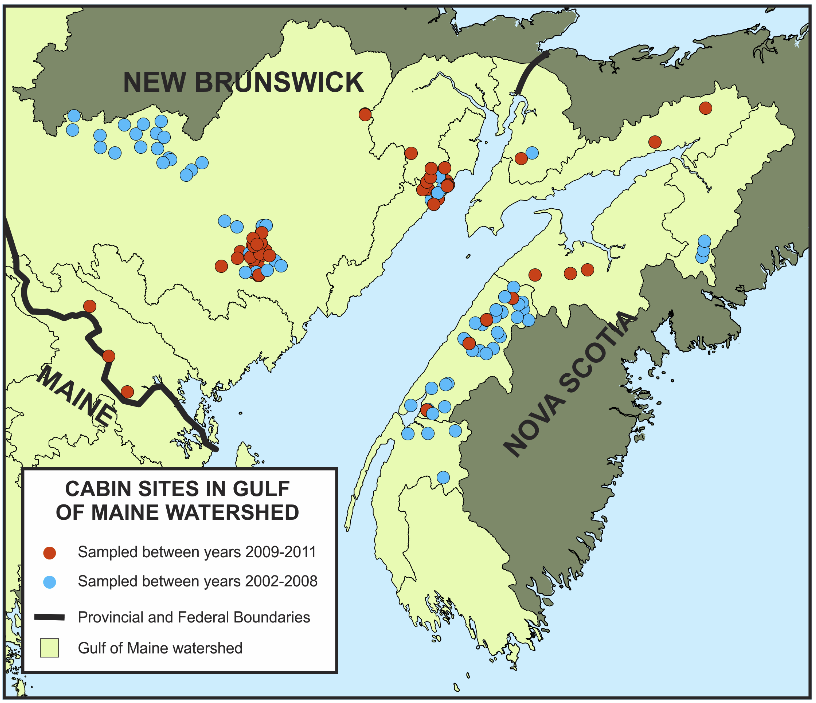
CABIN was designed for professionals in water quality monitoring and has been successfully applied by community watershed groups who want to expand their stream monitoring activities. The data within the CABIN database is gathered by all CABIN users including federal, provincial, territorial and municipal governments, environmental consultants, academia, First Nations, community watershed groups and industry. CABIN partners have collected 220 samples within the Gulf of Maine watershed and are adding to this number every year.
CABIN promotes inter-agency collaboration and data-sharing to achieve consistent and comparable reporting on freshwater quality across Canada. Standard methods are taught through the CABIN training certification program.
By using a standard method to collect field data, Environment Canada and its network of partners can share the resulting data to get a better understanding of aquatic ecosystem health in Canada.
To enhance collaboration, knowledge sharing and program development, Environment Canada and the Canadian Rivers Institute are coordinating the CABIN Science Forum 2012 in Fredericton, New Brunswick.
Register online to participate in the Forum in person or by webinar. Registration is free and early registration will assist us in planning for the event.
For more information email: cabinworkshop@ec.gc.ca.
Other News in the Gulf of Maine & Bay of Fundy
Past Journals
 Febuary 2015 — ESIP releases new smartphone app connecting people in the Gulf of Maine and watershed to the science happening all around them.
November 2015 — The launch of a marine debris program in the Bay of Fundy.
September 2015 — Climate Change Products for Atlantic Canada.
July 2015 — An update from the April 2015 State of the Bays Symposium in Massachusetts.
June 2015 — Learn about NH Department of Environmental Services' work with 65 volunteers to improve beach grass coverage at Hampton Beach State Park.
May 2015 — Nova Scotia recently released risk ratings for storm serge and sea level rise for all portions of the Province - this journal summarizes the findings
April 2015 — Learn about an exciting project between ESIP and EPA that seeks to unravel upstream pressures on downstream estuaries
February 2015 — Meet the new Project Leader for the Gulf of Maine Coastal Program in Falmouth, Maine - Jed Wright.
January 2015 — New Smart Tour of Great Marsh - largest continuous stretch of salt marsh in New England, extending from Cape Ann in Massachusetts to New Hampshire
December 2014 — The American Lobster Settlement Index is an important project that assesses current lobster fishery condition in both Canada and the US. The dataset is current and available through the ESIP Indicator Reporting Tool
Click here for all past ESIP journals