


May 2013 ESIP Journal
Volunteers Growing Hope for Oysters in New Hampshire
Great Bay, an inland estuary in New Hampshire, provides crucial habitat for many plants and animals, including oysters. Great Bay contains North America’s northernmost intact oyster reefs. Records show that as many as 900 acres of oysters lived in the bay as recently as 1970; currently fewer than 100 acres remain. Disease decimated the oysters in the 1990s.
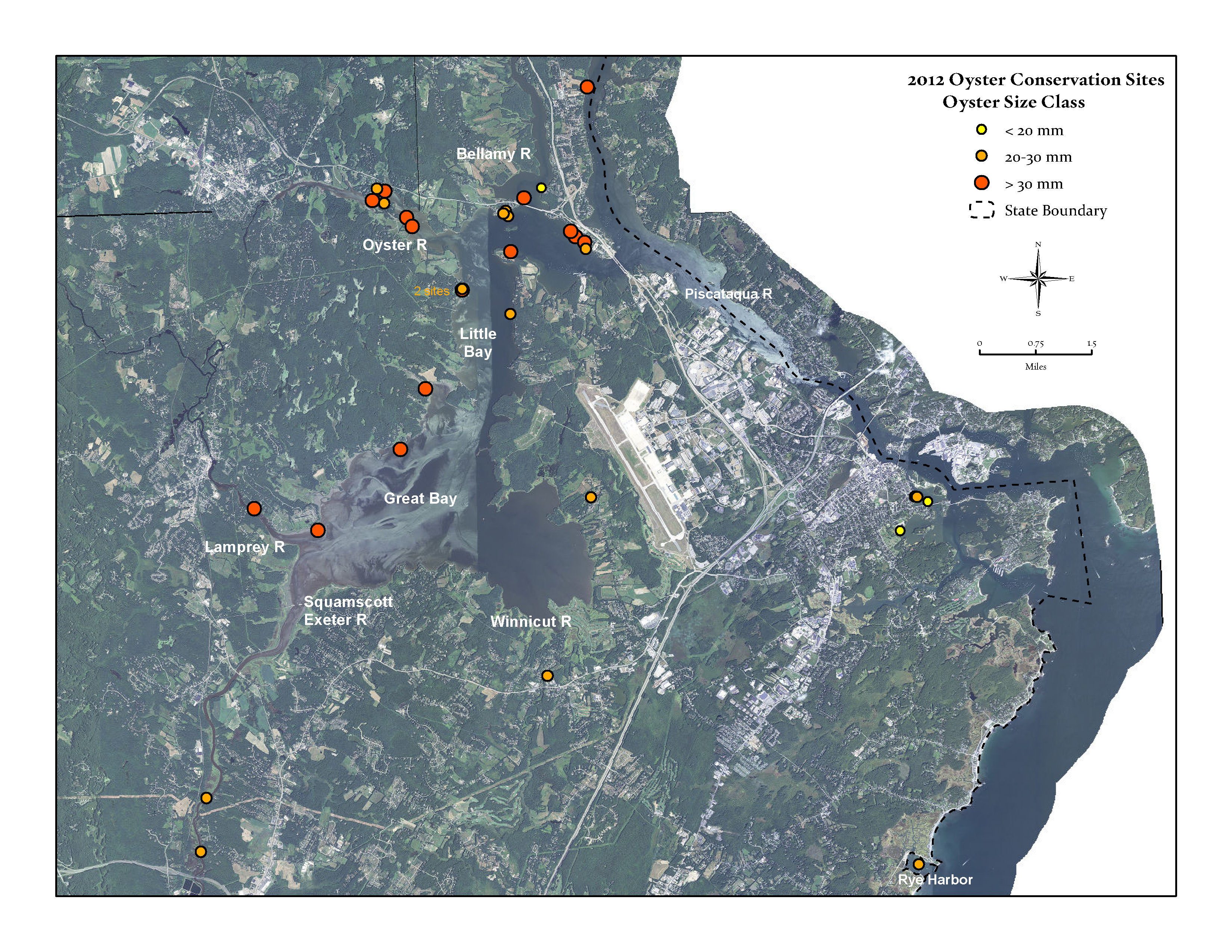 2012 Oyster Conservation Sites, Great Basin and Piscataqua River, New Hampshire |
Great Bay Estuary is in severe decline as a result of increased polluted runoff, especially higher nitrogen loads. The polluted runoff is largely caused by increased development occurring in the 52 communities within the 1,000-square-mile watershed that drains to the estuary.
The good news is that oysters can help clean the water by filtering out pollution. One oyster can filter as much as 20 gallons of water a day. To help restore Great Bay and improve its water quality, the Nature Conservancy coordinates the Oyster Conservationist Program, a partnership of several groups. The University of New Hampshire grows the baby oysters, or spat, at the University of New Hampshire Jackson Lab, and The Nature Conservancy trains volunteers and helps them grow oysters. In addition, the Coastal Conservation Association collects shells from local restaurants for the spat to grow on.
The local residents participating in the Oyster Conservationist Program have raised 50,000 oysters for restoration since the program began seven years ago. In 2012, 39 families helped grow baby oysters for restoration projects in Great Bay.
Each summer, oyster conservationists each receive a cage full of shells with the spat on them and host the babies in cages suspended from their docks until they are big enough to be moved to a Great Bay restoration site in the fall. Volunteers monitor their cages weekly to clean fouling from the cages and to pluck out predators, like green crabs, to help keep the oysters alive. They also measure the growth of the oysters biweekly.
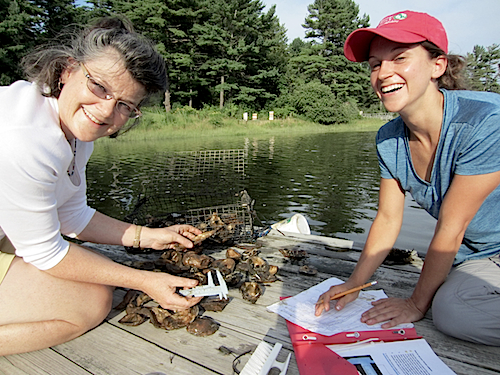 Elizabeth Dudley, volunteer, and Kara McKeton, oyster conservationist coordinator with The Nature Conservancy, measure baby oysters, or spat, being raised by Dudley in a cage off of her dock. The oysters will help filter Great Bay’s water. Credit: Cathy Coletti, New Hampshire Coastal Program; August 2012 |
Since 2000, oysters have been making a slow comeback with the help of the Oyster Conservationist Program and other restoration partners, like the New Hampshire
Coastal Program, and approximately 15 acres of oyster reef have been restored to Great Bay. The pace of recovery is increasing, with an additional 5 acres of restoration planned this year.
However, disease still threatens the oysters, shortening their lifespan to only four to five years. Although their lifespan is limited, the restored oysters are still able to filter pollutants from the water, which improves water quality and helps other fish habitat like eelgrass. This summer the Oyster Conservationists will continue the project and grow hope for the future of oysters in New Hampshire.
To find out more about the Oyster Conservationist
Program, visit www.oysters.unh.edu/oyster_conservationists.html
Other News in the Gulf of Maine & Bay of Fundy
Past Journals
 Febuary 2015 — ESIP releases new smartphone app connecting people in the Gulf of Maine and watershed to the science happening all around them.
November 2015 — The launch of a marine debris program in the Bay of Fundy.
September 2015 — Climate Change Products for Atlantic Canada.
July 2015 — An update from the April 2015 State of the Bays Symposium in Massachusetts.
June 2015 — Learn about NH Department of Environmental Services' work with 65 volunteers to improve beach grass coverage at Hampton Beach State Park.
May 2015 — Nova Scotia recently released risk ratings for storm serge and sea level rise for all portions of the Province - this journal summarizes the findings
April 2015 — Learn about an exciting project between ESIP and EPA that seeks to unravel upstream pressures on downstream estuaries
February 2015 — Meet the new Project Leader for the Gulf of Maine Coastal Program in Falmouth, Maine - Jed Wright.
January 2015 — New Smart Tour of Great Marsh - largest continuous stretch of salt marsh in New England, extending from Cape Ann in Massachusetts to New Hampshire
December 2014 — The American Lobster Settlement Index is an important project that assesses current lobster fishery condition in both Canada and the US. The dataset is current and available through the ESIP Indicator Reporting Tool
Click here for all past ESIP journals