


September 2015 ESIP Journal
Climate Change Products for Atlantic Canada
By Robert Capozi, Climate Change Adaptation Specialist
The Atlantic provinces Climate Change Secretariats in New Brunswick, Nova Scotia, Prince Edward Island, and Newfoundland and Labrador, along with St. Mary’s University, Dalhousie University, and engineering consultants CBCL Ltd., are in the final stages of creating an Adaptation Options Guidance document and Decision Making Framework for action on adaptation to climate change and sea level rise in rural, coastal Atlantic Canadian communities. This product will guide local decision makers to a selection of land use planning tools and engineering tools that are available to communities in order for them to adapt to coastal flooding and erosion. In order to decrease the risk of coastal hazards, communities must adapt by increasing their resilience through continuing education of coastal management strategies and approaches.
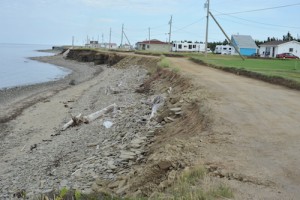
The Adaptation Options Guidance document describes in detail the five main adaptation strategies: procedural, avoid, retreat, accommodate and protect. Local examples are provided for each of the adaptation strategies. At the end of each strategy section is a list of adaptation tools that fall within that strategy type.
The document’s ‘Adaptation Approaches’ section discusses what is needed for a community to begin the adaption planning process and provides a list of principles that are considered necessary to create an informed and effective adaptation plan. This section ends with a step by step framework that discusses key information necessary for decision making.
The ‘Atlantic Canada’ section presents a brief overview of the Atlantic region through its characteristics and physical vulnerabilities related to the risks associated with rising sea levels and climate change.
The section ‘Coastal Settings’ addresses such factors as the scale of the issue to be resolved, the community’s capacity and objectives, as well as the planning horizon, all of which influence what adaptation tools are appropriate to use in addressing the community’s coastal issue(s).
The product has been tested in 8 Atlantic Canada coastal communities, where a full slate of stakeholders that included community leaders, decision-makers, targeted citizens who had been impacted by coastal issues in the past, and members of the general public, were guided through a test run of the product as it provided land use planning and engineering approaches appropriate to the issue and the communities capacity.
The product is expected to be rolled out to Atlantic Canadian communities by early 2016 with facilitation support where required from the provincial Climate Change Secretariats, so that a communities are aware of the product and use it for ensuring their sustainability as a coastal community. Studies are showing that it is more economically sound for communities to prevent rather than respond to the impacts of coastal hazards. Implementing an adaptation strategy requires considerable effort and time from community decision-makers and stakeholders; therefore it is in a community’s best interest to begin the process as soon as possible in order to increase preparatory planning rather than hazard response.
Further information can be obtained by contacting
Robert Capozi, Climate Change Adaptation Specialist
New Brunswick Climate Change Secretariat
New Brunswick Dept. of Environment and Local Government
506 453 8946
robert.capozi@gnb.ca
Other News in the Gulf of Maine & Bay of Fundy
Past Journals
 Febuary 2015 — ESIP releases new smartphone app connecting people in the Gulf of Maine and watershed to the science happening all around them.
November 2015 — The launch of a marine debris program in the Bay of Fundy.
September 2015 — Climate Change Products for Atlantic Canada.
July 2015 — An update from the April 2015 State of the Bays Symposium in Massachusetts.
June 2015 — Learn about NH Department of Environmental Services' work with 65 volunteers to improve beach grass coverage at Hampton Beach State Park.
May 2015 — Nova Scotia recently released risk ratings for storm serge and sea level rise for all portions of the Province - this journal summarizes the findings
April 2015 — Learn about an exciting project between ESIP and EPA that seeks to unravel upstream pressures on downstream estuaries
February 2015 — Meet the new Project Leader for the Gulf of Maine Coastal Program in Falmouth, Maine - Jed Wright.
January 2015 — New Smart Tour of Great Marsh - largest continuous stretch of salt marsh in New England, extending from Cape Ann in Massachusetts to New Hampshire
December 2014 — The American Lobster Settlement Index is an important project that assesses current lobster fishery condition in both Canada and the US. The dataset is current and available through the ESIP Indicator Reporting Tool
Click here for all past ESIP journals