Projects
Some of Gulf of Maine Council’s projects include grants and award programs, the Gulfwatch monitoring program, the Gulf of Maine Times, and science translation to management.
 |
Grants and award programs
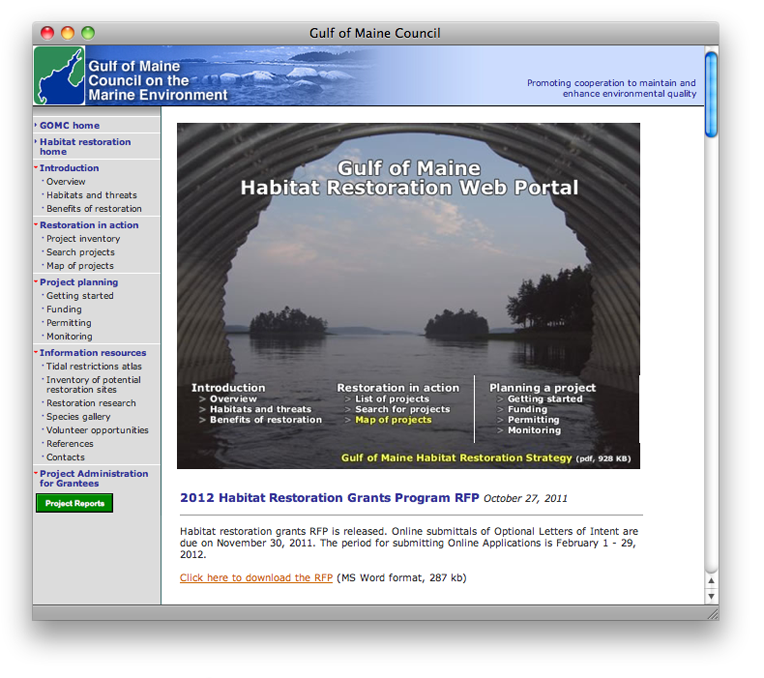
Habitat restoration projects have been implemented in each of the five states and provinces that border the Gulf of Maine—Massachusetts, New Hampshire, Maine, New Brunswick, and Nova Scotia—and more are being planned. Community groups, non-government organizations, and academic scientists are working in partnership with federal, state, and local governments to return tidal flooding to salt marshes, re-establish seagrass beds, improve fish passage in rivers, and accomplish many other types of restoration projects.
[ Click here for more ]
|
Gulfwatch monitoring program
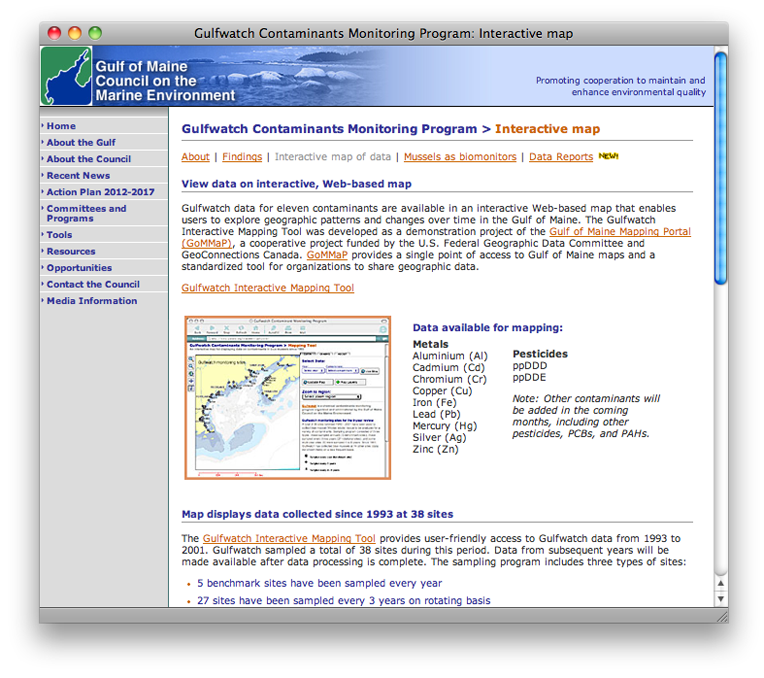
Gulfwatch is a chemical-contaminants monitoring program organized and administered by the Gulf of Maine Council on the Marine Environment. Since 1993, Gulfwatch has measured contaminants in blue mussels (Mytilus edulis) to assess the types and concentration of contaminants in coastal waters of the Gulf of Maine. It is one of the few monitoring programs and the only one in the Gulf of Maine to be coordinated across international borders.
[ Click here for more ]
|
 |
 |
Gulf of Maine Times
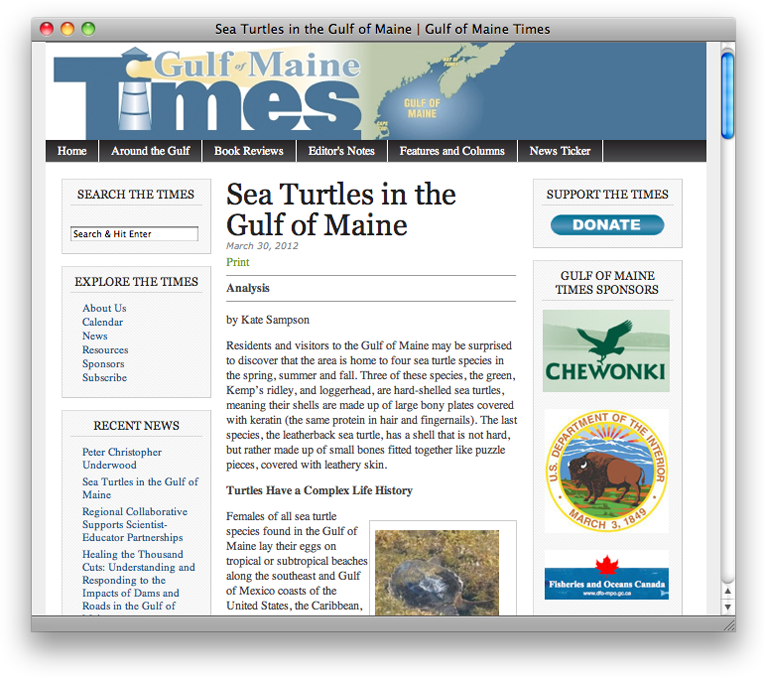
The Gulf of Maine Times, a project of the Gulf of Maine Council’s Outreach Committee, is made possible through support of the Gulf of Maine Council on the Marine Environment and the National Oceanic and Atmospheric Administration. The views expressed herein are those of the author(s) and do not necessarily reflect the views of NOAA or any of its sub-agencies, the Gulf of Maine Council on the Marine Environment, or other sponsors.
[ Click here for more ]
|
Science translation and management
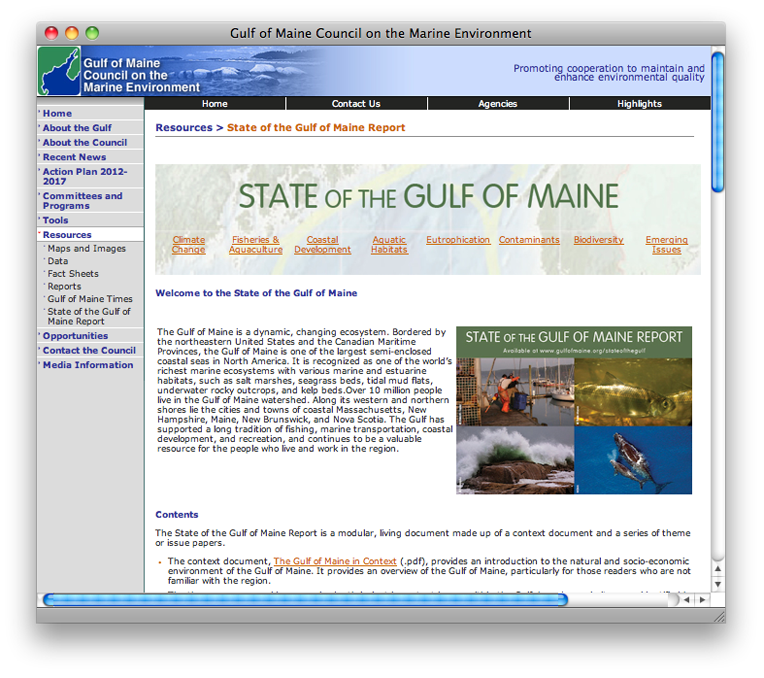
The Gulf of Maine is a dynamic, changing ecosystem. Bordered by the northeastern United States and the Canadian Maritime Provinces, the Gulf of Maine is one of the largest semi-enclosed coastal seas in North America. It is recognized as one of the world’s richest marine ecosystems with various marine and estuarine habitats, such as salt marshes, seagrass beds, tidal mud flats, underwater rocky outcrops, and kelp beds. Over 10 million people live in the Gulf of Maine watershed.
[ Click here for more ]
|
 |