

Environmental Quality in the Gulf of Maine
|
|
|
|
|
|
|||||||
|
|
|
|
Browse the archive |
|
|
|
|
As quarry conflict makes clear, Nova Scotia needs a coastal policy
By Andi Rierden, Editor
If you have visited the southwestern region of Nova Scotia you may have side tracked off Highway 101 down a narrow finger of land called Digby Neck. As one of the province’s premier tourist destinations, the Neck is a place where cozy fishing villages cluster along either side of a basalt ridge of hills called North Mountain. Here, long-time fishing families live side-by-side with “come from aways” and summer residents from the U.S. and Canada. On one side of the Neck lies the Bay of Fundy; its powerful tidal engine churning up a smorgasbord of diatoms, copepods and herring for a panoply of marine life including the endangered Northern right whales that come to feed their new-born calves in its cold waters. On the other side is the much calmer and warmer St. Mary's Bay, home to clam flats and lobster boats.
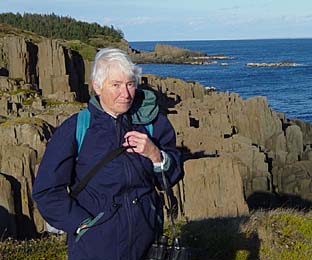 |
| Nora Peach in front of basalt columns on Digby Neck. Peach is an ardent advocate for sustainable coastal development and a quarry opponent. Photo: Isabelle Vilm |
In recent years, Digby Neck has been touted by economic development professionals for being a resilient and entrepreneurial community, struggling to survive by using the natural resources in sustainable ways. Each summer scores of nature oriented tourists enjoy a venue of wildflower walking tours, birding field trips and lots of whale watching. Also in store is the Fundy Discovery Centre, which will serve as an education and research outpost devoted to the Bay of Fundy. If ever there was a community determined to become a model of sustainable ecotourism, this is it.
Given the community’s fervid spirit, it is no surprise that many residents here were infuriated when a company from New Jersey, Clayton Concrete, announced plans two years ago to establish a 120 hectare [300 acre] basalt quarry and marine terminal on the Bay of Fundy coast near the hamlet of Little River. The operation would haul away some 2 million tons of gravel each year to the United States for construction, and return next to nothing to local residents.
The fact that the initial phase of the project escaped environmental review despite the clear fragility of this unique coastal ecosystem, further angered opponents who lost little time protesting at public meetings, and through letter writing campaigns, newspaper articles, petitions and vigils. They argued that blasting and quarrying would possibly damage the fishery, destroy their quality of life and bring new perils to the Bay of Fundy's endangered whale population at a time when federal officials had authorized shipping lane changes in the bay to protect the whales. Fishermen also worried that ballast waters discharged from ore carriers might introduce a species of paramoeba that caused a large-scale shellfish die-off a few years ago off New York. With their signature red and white “Stop the Quarry” signs brandishing the roadsides, shop fronts and front lawns, opponents pointed out that the quarry would provide the province with no royalties [Nova Scotia doesn’t require royalites on construction stone] and that it would create a mere handful of jobs. Still, the local legislator and key environment officials kept their distance.
Just when it looked like nothing could stop the rock crushers, the residents of Digby Neck found an ally in federal fishing Minister Robert Thibault. This past summer Thibault requested — given the magnitude of the operation and its potential impact on the region's ecology — a joint federal and provincial environmental assessment panel review of the quarry plan. The province agreed. Following a public comment period, a joint panel will study the impacts on the area and take public concern into consideration. The process has delayed blasting for at least a year.
For Nora Peach, one of the quarry plan’s most impassioned opponents, the environmental review is a good step, but it in no way signals the end to her struggle. As sure as the sun comes up over St. Mary’s Bay, the retired school teacher and conservationist is sure to be present at events even remotely to do with the quarry controversy. Her public scoldings of politicians and razor-sharp editorials have received wide coverage. In a recent editorial about the quarry review Peach asked: “As this process begins we feel that a threat hangs over us like the Sword of Damocles. Will the sword fall or will we be spared?”
Peach has long argued that all the anger and heartache the quarry plan has unleashed may have been avoided had the province instituted a policy to protect and regulate activities on coastal lands from what she calls, “large scale or unsuitable exploitation.”
She is not the only person to raise concerns about the coastal policy vacuum in Nova Scotia.
A pre-election survey conducted this fall by the Nova Scotia Environmental Network found that many of the issues that generate concern in communities around the province—the Digby Neck quarry, aquaculture development, seismic blasting and oil and gas exploration were among them—revolve around the lack of a comprehensive plan to regulate coastal development.
Nova Scotia is the only jurisdiction in the Gulf of Maine that does not have a coastal zone management strategy. Across the Bay of Fundy, neighboring New Brunswick has put the final touches on its new coastal policy that aims to “conserve the ecological integrity, character and territory of coastal features, to manage the development on coastal lands and to ensure public access to and use of coastal areas.” The policy regulates the types and location of development that can occur in or adjacent to the coastal zone. By establishing sensitivity zones of varying fragility, sensitivity and ecological significance, it identifies acceptable activities for coastal area planning and management.
As the Digby Neck quarry conflict brings home, Nova Scotia needs a similar policy of buffer zones and guidelines about the types of development activities allowed in various zones, which would help to protect coastal habitats and weed out unsuitable activities. The residents of Digby Neck deserve a special recognition for bringing this to light.