

Environmental Quality in the Gulf of Maine
|
|
|
|
|
|
|||||||
|
|
|
|
Browse the archive |
|
|
|
|
A much needed home for marine animals
Center will be the first to provide rehabilitation
By Maureen Kelly
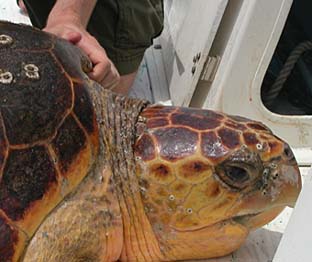 The Center’s two 12-foot diameter, five-foot high pools with circulating salt water will hold up to two loggerhead turtles (such as the one seen above) or more of the smaller Kemp’s ridleys. Photo: Mary Kay Fox |
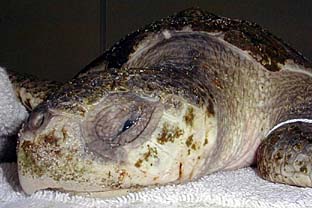
Each autumn, from late October to early December, sea turtles wash up on Cape Cod beaches, after migrating from the southern climes north along the Gulf Stream to the feeding grounds of Stellwagen Bank. Those turtles that linger on Stellwagen too late into the season can find themselves in intolerably cold waters when the ocean temperature dips. Then they strand on the Cape’s beaches in a torpid condition—known as “cold-stunned”—with slowed heart rate and breathing.
This year, the National Marine Life Center (NMLC) in Buzzards Bay, Massachusetts, (http://www.nmlc.org) will be ready to shepherd some of them back to good health. NMLC is in the first phase of constructing a marine animal rehabilitation hospital that will be the last stop off for turtles on their journey to recovery and release back into the wild.
For this project, NMLC is partnering with Massachusetts Audubon’s Wellfleet Bay Wildlife Sanctuary, which coordinates beach rescues of turtles, and the New England Aquarium, which provides critical care to turtles. By November, the NMLC was ready to accept some of these animals for the third stage of care—pre-release rehabilitation. When space permits, it will also take in seals. Eventually, the hospital will be equipped to treat whales, dolphins and porpoises as well.
Cape Cod is a prime location for such a center.
“More marine animals come ashore alive here than any other place in North America,” said Sallie Riggs, president of the NMLC.
Why strandings occur
Last year, about 200 turtles and 300 marine mammals were found stranded on Cape Cod. Though the cause of strandings is not always readily apparent, some animals beach due to natural causes resulting from ocean or weather conditions, or when escaping predators or chasing prey. Geography can be a factor also. The hook-shaped landmass of the Cape is known to trap animals in Massachusetts Bay.
|
|
Sometimes several factors are at play. The mass stranding of 57 pilot whales in Dennis in the summer of 2002, for example, might have occurred because the whales chased their prey into shallow waters and got stuck when the tide went out, or they might have been following a sick or disoriented leader.
Animals also end up on the beach because of human interactions, injured from entanglements in fishing gear or ship strikes or diseased from pollution. Last April, Buzzards Bay experienced a significant pollution problem when a barge spilled 15,000 gallons of oil into the bay putting wildlife at risk.
While a large number of stranded animals are found alive, until now, there have been no facilities to treat those in need of rehabilitation.
Rescuers from the Cape Cod Stranding Network (CCSN) act as emergency medical technicians for stranded mammals found from the Cape to the Rhode Island border, but they must transport the animals by truck to the nearest facilities, which are hours away. The New England Aquarium in Boston and the Mystic Aquarium in Connecticut are the closest treatment facilities to the Cape, but both have limited capacity to deal with rehabilitation cases.
As a result, rescuers must often go farther afield. When a harbor seal pup was found on Pilgrim Village Beach in Truro in October, Brian Sharp, assistant stranding coordinator for the CCSN, had to take the seal on a five plus hour drive to the University of New England in Maine.
Such lengthy road trips can be dangerous for sea life. The more time seals are out of the water, the more stressed they become, and this can lead to shock
Sharp said. Larger animals, like whales, can suffer under the crushing weight of their own bodies when not buoyant in water.
The NMLC will reduce transport time to within an hour.
Care for turtles
A part-time veterinarian, two animal care coordinators and volunteers will staff the first phase of the hospital. The facility will have two 12-foot diameter, five-foot high pools with circulating salt water pumped in from the nearby Cape Cod Canal. The pools will hold up to two loggerhead turtles each or more of the smaller Kemp’s ridleys, Riggs said. When not treating turtles, the facility can take in up to four seals.
The hospital will be prepared to provide wound care, treat and prevent infections and reverse shock in stressed animals. It will also provide physical therapy that could involve staff or volunteers working with injured animals to build up strength or to teach them to swim again.
 Workers assemble tanks for turtles and seals. Photo courtesy of Sallie Riggs |
Cold-stunned turtles will be warmed back to life. Often these turtles are dehydrated and undernourished, so they might need to be re-hydrated and have their electrolyte levels adjusted. They may also require treatment for pneumonia.
In the summer, recuperated turtles will be released back into the New England waters where they were found. Riggs hopes that the NMLC will have the funding to put satellite tags on the turtles, which could help clear up the mystery of the “lost years” by tracking where turtles travel during the 25 years or so before they return to the beach where they hatched.
Other likely patients will be injured seals and seal pups that have been separated from their mothers. The pups will need to be bottle-fed to build up blubber and food reserves and taught how to feed themselves.
For all NMLC patients, the main aim is “getting the animal back to the point where it can cope in the wild,” Riggs said.
Future plans for the facility include a 60-foot pool, with the capacity to house an animal up to 12-feet long. Plans are also under way to build a “Marine Animal Discovery Center” at the site with exhibits on marine animals, strandings, rescue and rehabilitation and human impacts on the ocean. Visitors will also be able to view animals receiving treatment and relay questions to caregivers. A director of education will be on staff to work with teachers to enhance science curriculums.
Fundraising for the NMLC is on going and Riggs expects that the entire facility will be completed in approximately two years.
Maureen Kelly is a regular contributor to the Gulf of Maine Times. She lives in Reading, Massachusetts.