

Environmental Quality in the Gulf of Maine
|
|
|
|
|
|
|||||||
|
|
|
|
Browse the archive |
|
|
|
|
By Sam Low
Some years back, I sailed on a PBS filming expedition to Satawal, a tiny Micronesian coral atoll in the Pacific Ocean, where I learned an important lesson about how folks can live in harmony with their natural resources. Satawal is a circular island, about one mile in diameter, where survival depends to a large extent on fish that inhabit nearby reefs. Powerful chiefs are considered the “owners” of the reefs (as stewards for all the islanders) and they husband these resources with great care. Whenever the stocks are overtaxed, they ban all fishing to allow them to revive.
 |
|
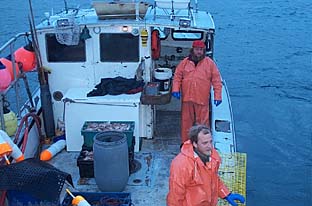
Monhegan lobstermen Photo: Carl Wilson, Maine Dept. of Marine Resources |
The ancient Hawaiians had a similar system to ensure sustainable use of their natural resources. It’s called an ahupua’a, a territory owned by a particular group—call it a tribe. The ahupua’a (pronounced ‘ah who pu ah ah’) was ideally a pie shaped slice of real estate running from the coast up to a volcanic peak. The area enclosed various ecological zones that enabled the cultivation of crops such as taro and avocado that liked the lowland heat and sweet potatoes that flourished in the cool uplands. Pigs, goats, native deer and wild cattle also dispersed themselves according to altitude and vegetation along the surface of the tilted pie shaped terrain. Villages were located along the shore where seafood was plentiful and canoes could be drawn up easily. The boundaries of the ahupua’a were known and transgression by another tribe would be forcefully rebuffed. Presiding over this territory was a high chief whose authority descended to him from the gods. The chief had the power of placing a Kapu on any of the ahupua’a’s natural resources – rendering them off limits. The penalty for breaking the Kapu was death.
In both these societies three things are at work—the presence of a small and unified community, the concept of a territory “owned” by that community and the ability to control its use to ensure a sustainable yield. Thinking about this reminded me of a conversation I had recently with a lobsterman from Criehaven, Maine, Charlie Stone.
“You can’t just fish here,” Charlie told me, “you’ve got to do two things—buy out an existing fisherman’s share and be accepted by the other fishermen.”
“How does someone get accepted?” I asked Charlie during a visit in the fall of this year.
“It helps if you are the child of a lobsterman from here,” Charlie says.
 |
|
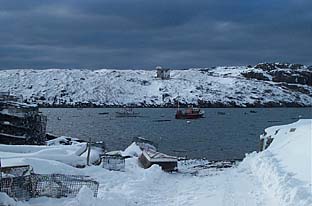
Monhegan lobstermen Photo: Carl Wilson, Maine Dept. of Marine Resources |
Like the residents of Satawal and the Hawaiian ahupua’a, the folks from Criehaven are a tight knit community who protect their territory, in this case by limiting the number of fishermen and the number of traps they can use (under certain state mandated limits). Those with the most intimate knowledge of the lobster stocks—and who depend on them for survival—are the caretakers.
An even more extreme example of this kind of husbanding is found among the lobstermen of Monhegan Island. As long as anyone can remember, Monhegan’s dozen or so lobstermen have staked out a territory surrounding their island and agreed among themselves to protect that resource. In 1974, for example, they limited themselves to 600 traps each. And traditionally they waited until New Years day to begin fishing and stopped on June 25th. Monhegan’s strong sense of community was expressed in the unwritten rule that fishing would not begin until all the fishermen were ready. If someone could not go lobstering due to an illness or equipment failure, the rest waited. Like the fishermen of Satawal, they figured it was “one for all and all for one” as far as harvesting the ocean was concerned.
Such an ethic is not uncommon in Maine, but what makes Monhegan lobstermen unique is that they have been able to codify the traditional “ownership” of their fishing territory into state law. The story goes something like this. In 1995, mainland lobstermen began to infringe on Monhegan waters. Their incursion led to a number of traps being destroyed on both sides and one Monhegan boat sinking mysteriously in nearby Port Clyde. It was obvious that further confrontations might lead to increased violence. So in 1998, the Monhegan fishermen convinced the state to create an exclusive lobstering zone—called the Monhegan Lobster Conservation area —extending for two miles around the island. Only Monhegan fishermen can harvest this zone and their previously informal rules were encoded in law—only 600 traps can be used and fishing is limited from January 1 to June 25.
Most traditional societies—such as those of Satawal and ancient Hawaii—own and defend territorial rights to scarce resources and have evolved means to protect them from overuse. In a democratic and ‘free market’ society like ours, however, we are more likely to consider the open ocean as a common area available to all. By placing the protection of precious lobster resources in the hands of those who depend on them, the state of Maine has come up with a model that may serve in other areas and for other resources as well. Long-time Monhegan lobsterman Doug Boynton (quoted in a New York Times article) puts it succinctly: “What has kept lobstering a healthy fishery is that people have had to look after their own back yard. We had to be sure that next season there was something there.”
Sam Low is a filmmaker, journalist and Harvard-trained anthropologist with an interest in marine history and conservation issues. He is part Hawaiian and is at work on a book about his Hawaiian family. Low divides his time between Maine, Hawaii and Martha's Vineyard.