



Living Shorelines
Living shorelines represent a natural defense against coastal flooding and erosion. A growing number of resources are available to help landowners and communities stabilize shorelines using nature-based strategies. Read more »
Read More
Find Regional Climate Data Online
Climate research, reports, tools and resources from around the Gulf can be found in the NExUS database.
Read More


Climate Adaptation Strategies around the Gulf
The Climate Network has a study on the status and needs of climate adaptation in municipalities bordering the Bay of Fundy. Read more »
Read More
Climate Network Dashboard
A new dashboard offers recent and real-time climate data for the northeast US and Atlantic Canada. Read more »
Read More
Extreme Precipitation in the Gulf of Maine Region
Extreme precipitation events are a growing regional concern. To learn more about challenges and responses. Read more »
Read MoreExtreme Precipitation in the Gulf of Maine Region: Challenges and Responses
The Gulf of Maine region is experiencing more extreme precipitation events, raising concerns about flooding, damage to infrastructure, increased discharges from combined sewer overflows, and greater stormwater runoff impacts (from eutrophication to waterborne diseases). In combination with warmer temperatures, extreme precipitation events can aggravate spread of diseases such as tick-borne illnesses.
In June 2017, the Climate Network hosted an hour-long session with guest speakers and an overview of resources that the Climate Network has developed to help regional communities get access to sound science to aid in decision-making (e.g., the new Extreme Precipitation in Atlantic Canada website, the Climate Dashboard and the Gulf of Maine Region Climate Impacts and Outlook quarterly).
Two guest presenters–Cliff Sinnott, Executive Director of the Rockingham County Planning Commission in New Hampshire, and Rob Capozi, Adaptation Specialist with the New Brunswick Climate Change Secretariat, shared innovative approaches that their jurisdictions are taking to address this challenge.
To view the video of this session, click here
- Precipitation from extreme events in the GOM region has increased 74 percent since 1958 (NOAA).
- Extreme weather already poses economic and ecological challenges, and these events are expected to grow more frequent in coming decades, with precipitation increasing 5-9 percent (IPCC 2013).
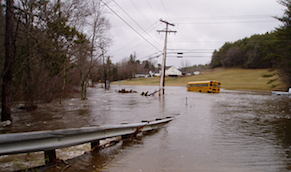
Credit: Sherry Godlewski
- By 2050, climate scientists project a more rapid increase of 2.5 to 3.5°C (4.5 to 6.3° F) in regional air temperature (IPCC 2013).
- Temperatures in the Gulf of Maine have risen much more in recent decades than many other coastal waters around the world, and a 2012 "heat wave" in sea surface temperatures had damaging economic impacts.
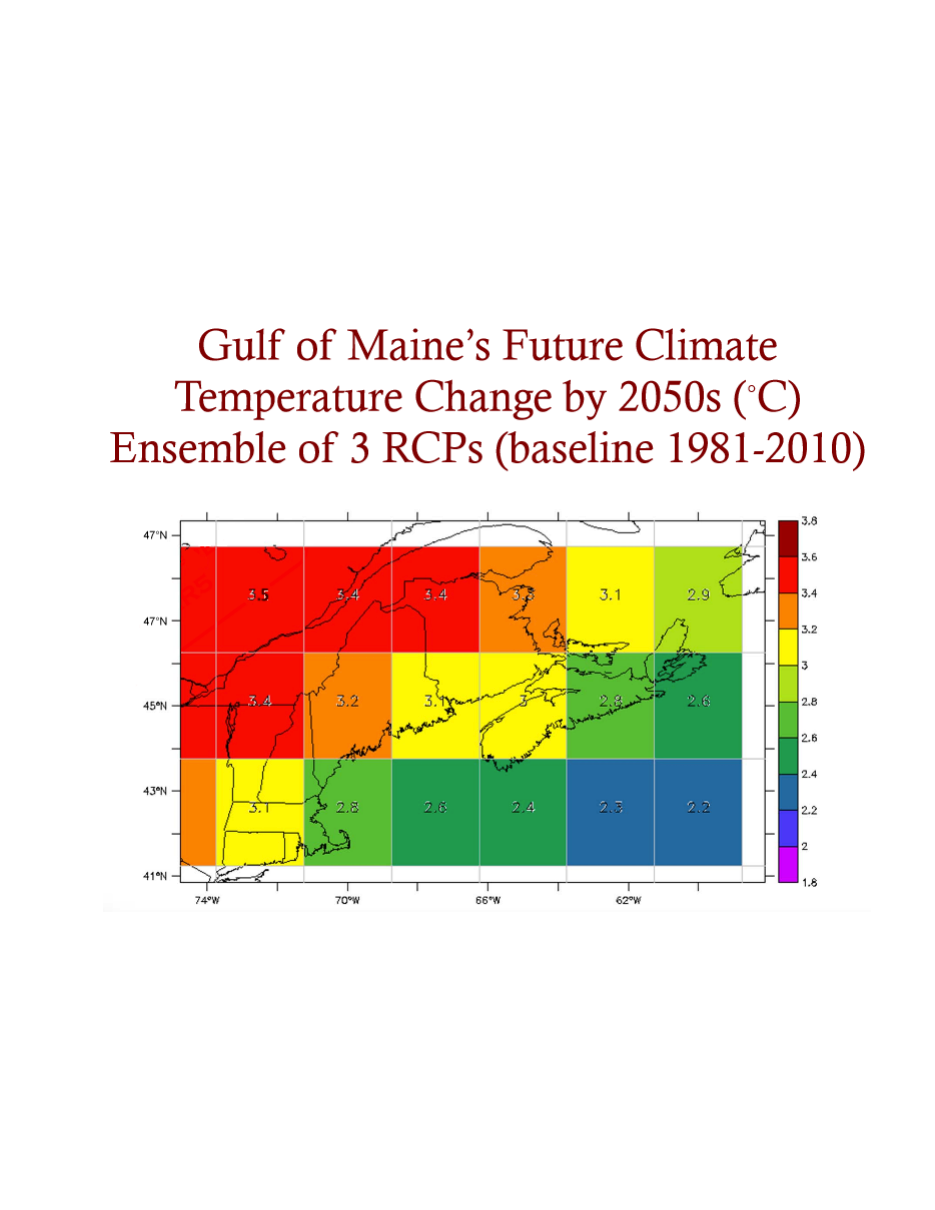
Projected Temperature Changes in the Gulf of Maine Region by the 2050s (°C.), reflecting the most recent IPCC models (Credit: Adam Fenech, UPEI Climate Lab)
What’s Climate Change and What’s Just the Weather?
This one-minute animation by Ole Christoffer Haga, produced by Teddy TV for the Norwegian Broadcasting Corporation, clearly and humorously illustrates the difference between long-term climate trends and variable weather patterns.
Funding support for the Climate Network is provided by:

